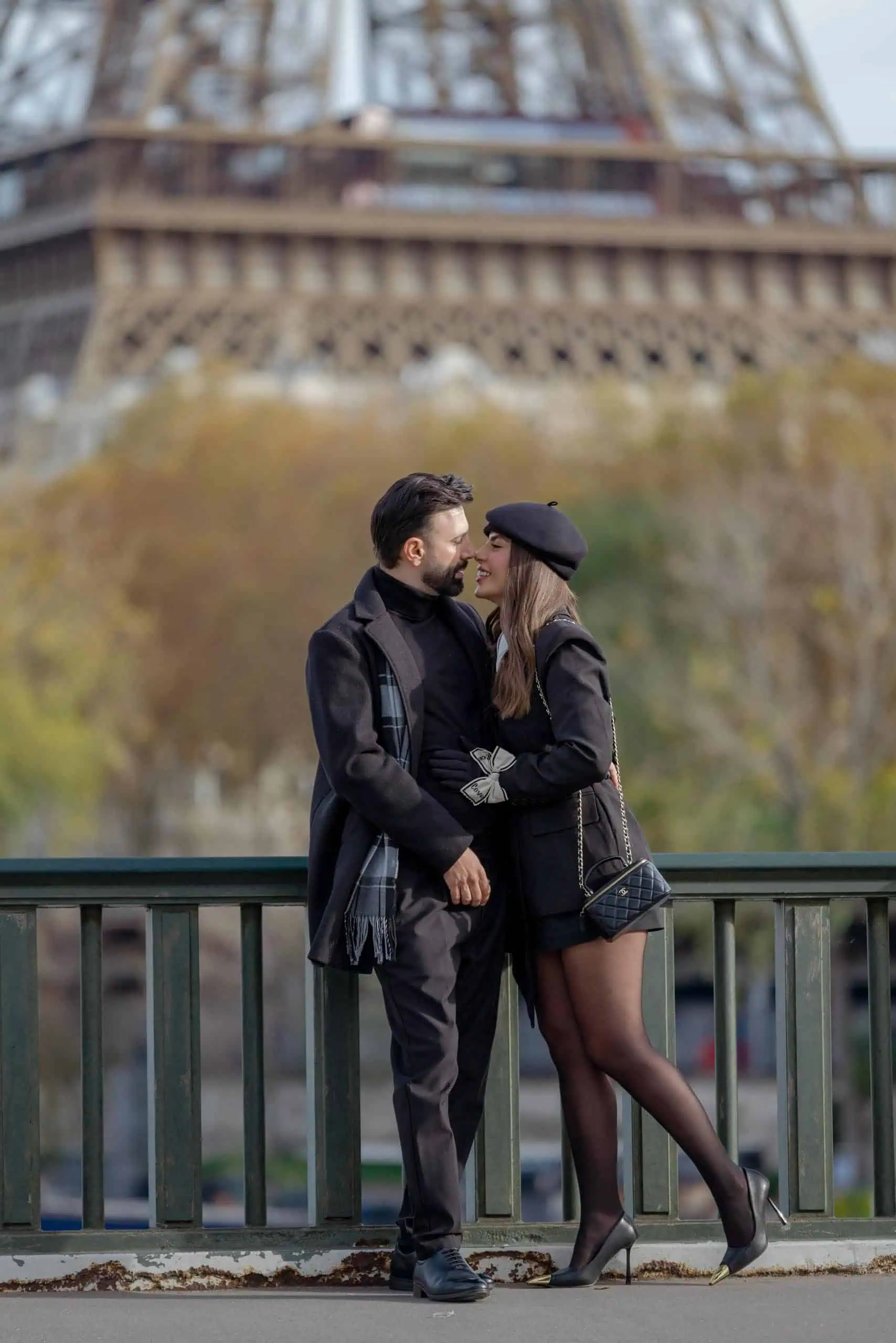
May and September lead, with month-by-month light, weather and crowds
May and September are the two best months to visit Paris, and May is the best month for a photoshoot, with the wider sweet spot running from late April to mid-June and from mid-September to mid-October. Those months give you mild temperatures, leaves on the trees and enough daylight to choose your light.
Below you will find each season's weather, daylight, crowd level and Eiffel Tower night timing, so you can match a month to your trip dates. It is for couples, families and anyone with flexible dates. A month decides how many hours of good light you get and how many people share your location. The wrong month still works, but the plan changes.
May is the best month for a Paris photoshoot. Daytime highs average about 20°C, and most days you can finally ditch the heavy layers. September is the close second: warm golden light, average highs of 21.5°C, and a Paris that has refilled after the summer exodus.
The official Paris tourist office,Paris je t'aime, states "Spring (April to June) and autumn (September to October) are the ideal times to explore Paris." That matches what I see in my diary. Golden hour slots in April, May, September and October are the first to fill.
"If someone has flexible dates, I say May or September, then I build the session around the light," Finzi says. "The month gets you the weather. The time of day gets you the photo."
TipCan't pick? Send me your trip dates and I will tell you which day has the best odds.
| Package | Price | Duration | Photos | Locations |
|---|---|---|---|---|
| Essential | €300 | 1 hour | 30 photos | 1 location |
| Signature | €500 | 2 hours | 50 photos | 2 locations |
| Prestige | €800 | 3 hours | 60 photos | 3 locations |
March still carries a winter chill, averaging 5 to 12°C, with sunny stretches one hour and a shower the next. April warms to average highs of 17°C. May is the most reliable of the three for comfort, though it is also the wettest month by rainfall. It still logs about 202 hours of sun, so rain tends to arrive as showers, not whole days.
Late April to mid-May is the window when gardens are reopening, days are lengthening and the worst summer crowds have not arrived. This is when open green settings such as the Luxembourg Gardens work well for couples and multi-generational families, with the lawn lit warm at golden hour.
"Spring weather can change inside one session, so I always have a sheltered option in mind," Finzi says. "The lower walkway at Bir-Hakeim works well when a shower passes."
TipPack a light layer for spring. The mornings are cooler than the forecast high suggests.
June is the strongest summer month. It brings about 15.9 hours of daylight and a 23.7°C high. July is the sunniest month, with about 222 hours of sunshine, and its average high reaches 27°C. Hot spells do happen: each year there are a few days when the temperature rises above 32°C.
Summer has the longest days and the most people. Paris hotels are fullest in June, September and October, and in the middle of the day the light is harder and the crowds are at their peak. I use shade and backlighting at that hour, which suits families with high energy. For couples I move the session to the start or end of the day.
August is a different mood. Paris Plages is its highlight and locals are on holiday, so the city has a more relaxed pace, though landmarks stay busy.
"In July and August I protect the edges of the day," Finzi says. "Soft light, cooler air, fewer people in the background. Midday is for shade and short walks."
TipIn a heatwave, tell me early. We shift to the cooler edges of the day and keep walking short.
September keeps the summer warmth with fewer people. The August closures are over and fashion week energy returns, and the month still has about 175 hours of sun. Mid-September to mid-October is the strongest autumn window.
October brings colour, with trees turning adding to the city's photogenic mix. The cost is light: October averages about 119 sun hours and 10 rainy days, with highs near 18°C. Expect grey days, so I plan earlier starts and keep a rain option ready.
Late October can be busier, since half-term and fall colour bring visitors. November is cooler, with highs near 12°C and about 70 sun hours. The second half of November is one of the quieter windows of the year.
"October gives me colour in the trees but fewer hours of light, so I schedule earlier and keep the route compact," Finzi says.
TipFor autumn colour, ask for a tree-lined location such as the Luxembourg Gardens.
Yes, winter works if you want quieter locations and shorter queues and can accept cool, grey weather and short days. Temperatures run 4 to 10°C with occasional rain, but the headline sites stay open and queues are short. The cost is light. January has about 59 hours of sun and December 57, and December has about 12 rainy days.
Winter has its own pull. Mid-December is when the decorations are up. Dark comes early, so a Night Session with the Eiffel Tower lit is easy for families and anyone who prefers to be done by dinner.
"Coats are part of the picture in winter, so I choose spots where the stone and the light behind you do the work," Finzi says. "Bring gloves you can take off quickly."
TipWinter daylight is brief. Choose one or two locations close together and keep the walk short.
The month sets when your night session happens, because the Tower's sparkle follows nightfall. According to the official Eiffel Tower site, the golden lighting switches on automatically at dusk, and the sparkle runs every night at the start of each hour for 5 minutes. The first sparkle falls on the first full hour after dark.
In summer, nightfall is late and the sparkle runs each hour until 1am while the Tower stays open later. A June night session therefore starts late. In winter, nightfall is early and the same shoot fits a normal evening.
The Night Session is €450 and takes place after sunset with the Eiffel Tower lit. "The sparkle lasts only five minutes, so I plan for us to be in position before the hour," Finzi says. "The rest of the session uses the golden lighting and city glow."
TipTell me your dates and I will work out when the first sparkle falls.
Light rain does not cancel a session, and if you would rather wait for dry weather, rescheduling is free anytime. Paris rain is mostly gentle: light rainfall is distributed evenly throughout the year. No month is rain-free, but July has about 7 rainy days against about 12 in December.
Light rain gives dramatic skies and intimate moods, and I work in most conditions. Wet stone reflects the Tower and the lamps. Sheltered spots such as the lower walkway at Bir-Hakeim or covered arcades keep the session moving.
"Rain changes the plan, not the quality," Finzi says. "I check the forecast and the light, and if it looks like a wash-out, we pick a new date together."
TipPack a compact umbrella in a neutral colour. It can work in the frame.
Book 2 to 4 weeks ahead, and earlier for April to October, which is peak season. Golden hour slots in April, May, September and October go first. Paris hotels are fullest in June, September and October, which is a good sign of when the city is busiest. Winter dates are easier to secure.
A €30 non-refundable deposit locks your date, and rescheduling is free anytime if the weather or your plans change. Delivery is within 24 hours of your session.
Packages set your time and locations, and sessions involve 3 to 5 km of walking. Essential is €300 for 1 hour, 30 photos and 1 location. Signature is €500 for 2 hours, 50 photos and 2 locations, and it is the most popular. Prestige is €800 for 3 hours, 60 photos and 3 locations. A Proposal session is €300 for 1 hour with a hidden camera.
TipSend me a date range instead of a single day. I will suggest the best day inside it.
Quick answers to the questions visitors ask before they book.
“It was very special. Finzi is very caring and enjoyable. It was a dream photoshoot experience.”
Pick a session. Choose a date. I handle the rest.
BOOK NOW