What is allowed, what is checked, and what to leave at the hotel
Yes, you can photograph the Eiffel Tower for personal use. Photographing it from public streets, parks and bridges is free, and personal photos from the first, second and summit platforms are permitted too. The limits are tripods inside the Tower, drones anywhere near it, and commercial use of night images showing the light display.
This page is for visitors planning photos, a session, or a visit to the Tower on the same day. It covers what security will check, what happens with tripods and drones, how the night lights are treated, and what can close the Tower or the surrounding access. I am based on Avenue de Camoëns, beside the Tower, so these are the rules I work around every week.
Yes, photography for personal use is allowed at the Eiffel Tower, both around it and on its platforms. The operator, the Société d'Exploitation de la Tour Eiffel (SETE), states that views taken by private individuals for private use do not require prior agreement. That covers holiday photos, couple portraits, family photos and posts on your own social media.
The structure itself is treated differently from its lighting. The Tower during the day is in the public domain, and the structure has been free for anyone to photograph and publish since 1990. The night display is a separate case, covered further down.
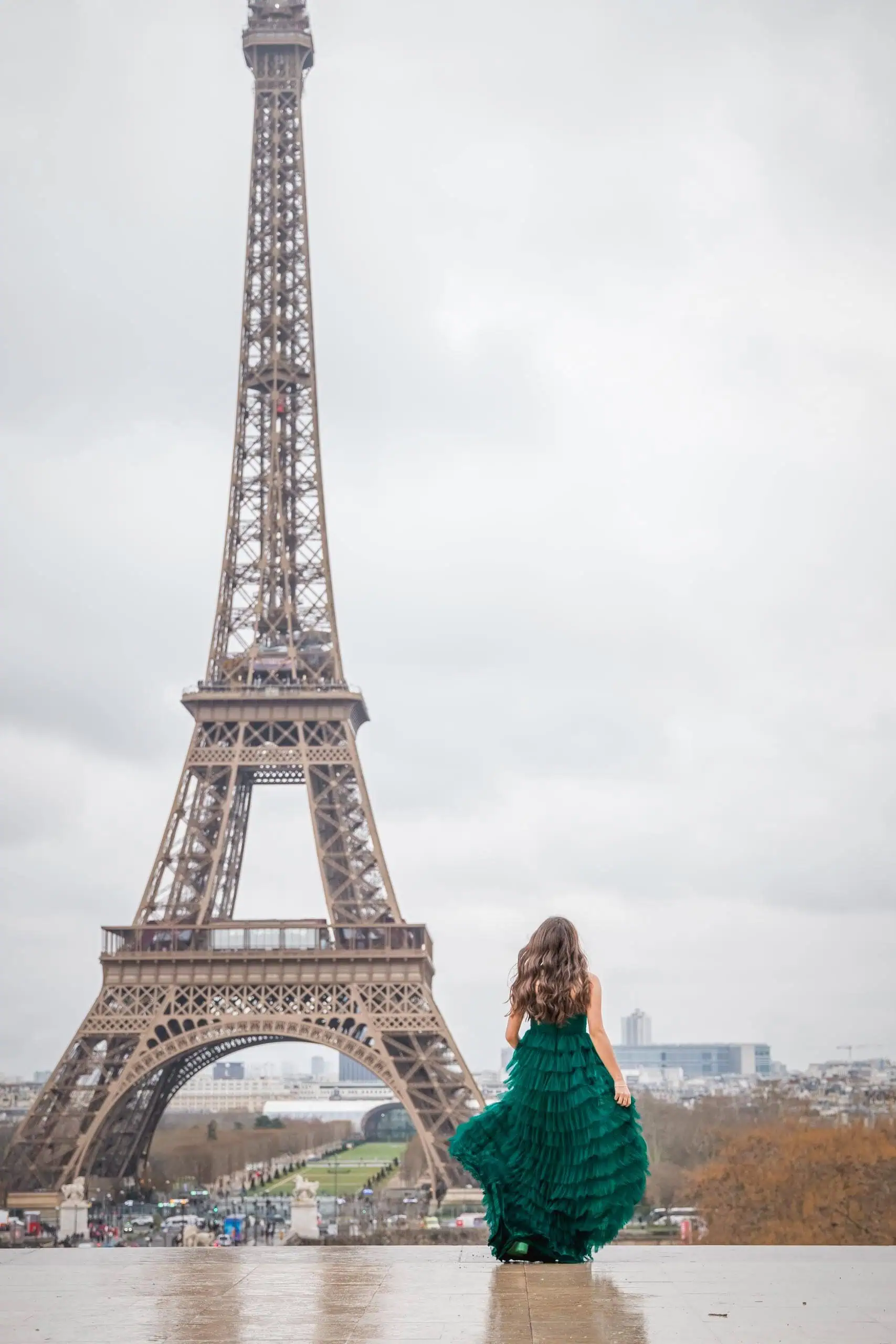
A session with me counts as personal photography: you are the subject, the Tower is the backdrop. Sessions run on foot across 3 to 5 km depending on your package, so what matters most is where we stand and when, not a permit.
TipDaytime or night, for your own album or your own feed, you do not need to ask anyone.
| Package | Price | Duration | Photos | Locations |
|---|---|---|---|---|
| Essential | €300 | 1 hour | 30 photos | 1 location |
| Signature | €500 | 2 hours | 50 photos | 2 locations |
| Prestige | €800 | 3 hours | 60 photos | 3 locations |
Everyone entering the Tower goes through two security checks, and the camera bag is part of both. The official Tour Eiffel visit tips say all visitors pass a first check at the main entrances and a second one before the elevator or stairs. The operator advises you to allow 15 to 20 minutes for the initial check, and a timed e-ticket does not remove that queue.
Bags are where photographers get caught out. The operator states "Large bags, bikes, and scooters are not allowed", and there is no storage facility on site. The operator's practical guide adds that security teams cannot make exceptions or store restricted items. If you arrive with a full camera backpack plus luggage, you are turned around at the gate.
Do not leave a bag unattended at any point. An abandoned bag on the Tower can lead to the perimeter being secured, a floor evacuated, or bomb disposal being called in. Keep your equipment on you.
"I tell clients to bring the phone and one small camera, nothing else," Finzi says. "On a walking session you do not want a bag you are guarding."
TipVisiting the Tower on departure day with luggage does not work. Store bags elsewhere first.
No, not inside the Tower. Tripods are prohibited inside the Eiffel Tower, including its decks and summit. The restriction fits the lifts, the narrow viewing areas and the crowded circulation routes.
Outdoors, the picture is less clear. For personal photography, a small tripod in public spaces like the Champ de Mars or Trocadéro is generally tolerated, but security can move you along if you block walkways or look like a commercial production. Some visitor guides report stricter treatment on the parvis directly under the Tower, so the answer can change by spot and by day.
My approach: treat a tripod as something you may be asked to put away, and plan the photos so you do not depend on it. For a night shot, a wall, a bridge parapet or a steady stance often does the job. If an officer or guard asks you to move, move.
TipA tripod you cannot use is dead weight over a 3 to 5 km walk.
No. Drone flights are prohibited across the Paris area without specific authorisation from the Préfecture de Police, including around the Eiffel Tower, the Champ de Mars and the Trocadéro. Violations can lead to heavy fines and confiscation, and a drone also appears on the list of items refused at the entrance.
If you want height in the frame without a drone, the ground offers it. The Trocadéro terraces and the bridges across the Seine give elevation with no permit needed. Those are the vantage points I use for wider compositions.
Leave the drone at the hotel or at home. Bringing it to the Champ de Mars only creates a conversation with police that nobody wants on a holiday.
TipFor a high angle, use the Trocadéro terraces instead.
The sparkle is where photography rules get specific. The twinkling light display, first installed in 1985, is a separately copyrighted artistic installation. For you, that changes nothing: personal and social use of night photos is fine.
The line moves when a photo has a commercial purpose. Night images featuring the light show require SETE authorisation for commercial use. That includes promoting a business, selling a product, or licensing the image to a stock agency. Daytime images of the structure carry no such restriction.
If your session photos might end up on a business website, a brand page or a publication, tell me when you write, before we plan the location and time. If the plan is a private album, a framed print or your own feed, there is nothing to arrange.
The Night Session is €450 and takes place after sunset with the Tower lit. It is the one to book if the sparkle is the point of the photos.
TipNot sure whether your use counts as commercial? Ask before the session, not after.
Weather and security can both change what you can reach. The official rates and opening times page warns that access to the top may be prohibited during harsh weather or peak periods. It also states that all public spaces may be closed if required, and bag and parcel checks put in place.
For a photo session, the practical effect is on the ground: a closed or restricted area can shift where we start. Because I work from Avenue de Camoëns, I check the approach on the day and move to another vantage, such as Trocadéro or the Bir-Hakeim bridge, when needed.
"I look at the access on the morning itself, not the night before," Finzi says. "If one side is closed, the Tower is still visible from three or four other places, and I pick the one with the best light."
If the weather or a closure makes the day wrong for you, rescheduling is free and available anytime. A €30 non-refundable deposit locks your date.
TipCheck the operator's site on the morning of your visit, because conditions can change.
Bring: a phone or one compact camera, a small bag, comfortable walking shoes, and layers. Leave at the hotel: drone, large camera bag, luggage, glass bottles and anything sharp. Glass bottles, sharp objects, weapons, drones and fireworks are prohibited at the base.
Decide your goal before choosing a package. Essential is €300 for 1 hour, 30 photos and 1 location. Signature is €500 for 2 hours, 50 photos and 2 locations, and it is the most popular. Prestige is €800 for 3 hours, 60 photos and 3 locations. A proposal session with hidden camera is €300 for 1 hour. Delivery is within 24 hours on every session.
Tell me your dates and the session you have in mind, and I will work out the location and timing around the access rules.
TipPick a session. Choose a date. I handle the rest.
Quick answers to the questions visitors ask before they book.
“It was very special. Finzi is very caring and enjoyable. It was a dream photoshoot experience. His artistic vision has collected very beautiful and special memories for us.”
Pick a session. Choose a date. I handle the rest.
BOOK NOW