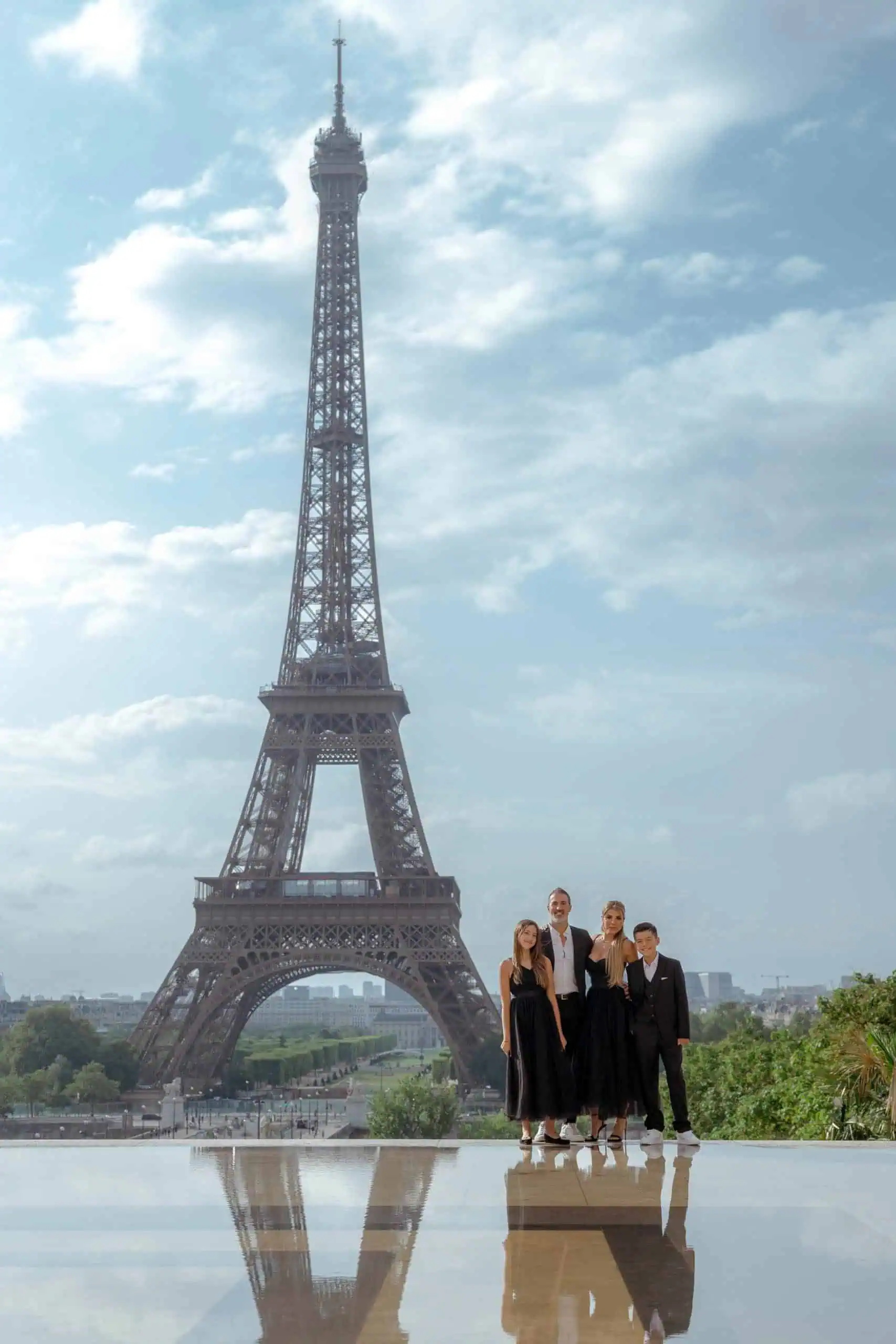
What to agree before booking, and how to share busy Paris spaces
The unwritten etiquette comes down to three habits: agree the plan before the day, keep shared space clear while you shoot, and move on when your turn is done. Paris landmarks see photo sessions all day, and nobody minds one that is quick, quiet and considerate.
This guide is for visitors hiring a photographer for a couples, family or proposal session at busy sites such as Trocadero, the bridges and the Tuileries. It covers what to settle at booking, how to behave on stairs, bridges and residential streets, and who sets the rules in each kind of place. I am Finzi, and this is what I tell clients before the session.
Agree the date, the locations, who is in the photos and what the package includes before you pay the deposit. A €30 non-refundable deposit locks your date, so the plan should be clear first. Essential is €300 for 1 hour, 30 photos and 1 location. Signature is €500 for 2 hours, 50 photos and 2 locations. Prestige is €800 for 3 hours, 60 photos and 3 locations.
The location count matters for etiquette as well as photos. Every extra stop means more time in shared space, so a one-hour session at one well-chosen spot is easier on everyone than a rushed tour. Tell your photographer who is coming: the ages of any children, anyone who walks slowly, and whether the session is a surprise. Sessions involve walking 3-5 km, so say so early if that is a concern.
I work alone, I edit every image myself, and I communicate in English, so every question goes to one person. Rescheduling is free and available anytime. If the weather or your travel plans change, message me and we move the date.
TipSend your dates, preferred locations and session type in the first message. That is all I need to start.
| Package | Price | Duration | Photos | Locations |
|---|---|---|---|---|
| Essential | €300 | 1 hour | 30 photos | 1 location |
| Signature | €500 | 2 hours | 50 photos | 2 locations |
| Prestige | €800 | 3 hours | 60 photos | 3 locations |
No, a guided session is a normal sight at Paris landmarks, as long as you keep paths, stairs and queues clear and leave the spot once the frames are done. The rude version is the group that claims a staircase for half an hour and asks everyone to wait.
"I take the frame in a few minutes and step aside, because the next group is after the same light," Finzi says. A fixed spot is rarely needed anyway. The light at the Eiffel Tower changes every fifteen minutes, so moving along improves the pictures as well as the manners.
Trocadero shows the pattern well. The main viewing platform is packed all day, every day, but one level down or on the side staircases the crowds thin dramatically. Taking your session to the lower terrace is the polite choice and the better photo. Weekdays are quieter than weekends, and sunrise is nearly empty.
TipIf a spot is full, say so and we go to the next one. There are over 30 locations to choose from.
On stairs, shoot from one side and leave the middle open for people walking up and down. A clear lane behind you also keeps your photos clean, because nobody is squeezing past in the background. The side staircases at Trocadero work well for this: they give dramatic framing and far fewer people than the main plaza.
Bridges are commuter routes first. Pont de Bir-Hakeim is a steel bridge where the metro passes overhead and the wide walkway gives several angles, so there is room to work without blocking anyone. Even so, pause the pose when a cyclist or a pushchair needs to pass. It costs a few seconds, and it is the habit locals notice. Timing helps here more than anywhere else, because at sunrise the bridges are nearly empty and by mid-morning they fill with tourists.
Along the Seine, the stretch between Pont de l'Alma and Pont d'Iéna has quiet alcoves where you can be alone even in peak season. Quayside paths are shared with walkers and runners, so keep your group to one side of the path.
TipEarly is the easiest etiquette: fewer people means fewer interruptions for everyone.
Wait rather than ask people to move. If another group is shooting at your chosen spot, stand out of their line and let them finish. They will do the same for you. Do not photograph over the shoulders of a queue at a popular viewpoint, and do not cut in front of people waiting for their own picture.
Strangers in the background are part of a Paris photo, and a good photographer frames you so the crowd fades without removing anyone. There is one point worth knowing about publishing.Service-Public.fr, the French government's information portal, states that even in a public place, people who appear isolated and recognisable must agree to the image being published. In practice, do not ask your photographer to single out a passer-by, and keep other people's children out of your frame.
If someone asks you not to include them, simply reframe. It takes one second and keeps the atmosphere friendly for the rest of the session.
TipPosting a group photo that happens to show strangers is different from posting a portrait of one. When in doubt, crop.
Some of the best Eiffel Tower views are on streets where people live. A short quiet street in the 16th arrondissement has a direct, unobstructed view of the Tower, and a residential street in the 7th has the Tower framed between two rows of Haussmann buildings. Both are best at sunrise, when there are no parked cars and the light hits the facades directly.
Keep your voices low, stay off doorsteps and do not lean on building doors or gates. Keep clear of garage entrances and parked cars, and do not block the pavement for anyone with a pushchair or shopping. If a courtyard door is closed, it stays closed. Open courtyards in the Marais are a different case, and I shoot them early before the shops open, when the light is soft and the streets are calm.
Early starts are the best etiquette tool. Residents are not yet out, the streets are empty, and nobody needs to wait for you.
TipFinish residential streets first and move on to busier spots as the day fills up.
The body that manages each place sets its rules: the City of Paris for its streets, bridges and municipal gardens, and the Louvre for the Tuileries and Carrousel grounds. Rules differ site by site, which is why a plan that works on a bridge may not work in a garden.
The City of Paris runs a dedicated office for this. Its page says Paris Film is the "single point of contact for submitting permit applications for filming" in public spaces managed by the City, and the shoots it lists include artistic photography. The same page describes a lighter notification route for small teams with lightweight equipment and no parking or traffic requests.
The Tuileries have a different manager. The Louvre's published regulation for its courtyards and gardens makes professional photography subject to prior written authorisation from the head of the Louvre's public body, and it applies to the Tuileries and Carrousel gardens as well as the Cour Napoléon.
As a client, you do not need to read these documents. You do need to ask your photographer how the plan fits each of your locations. Tell me your preferred locations when you contact me and we settle the route from there.
TipCheck the manager's own website for current rules before relying on any summary, including this one.
Arrive at the agreed meeting point on time, in shoes you can walk in for 3-5 km, and tell your photographer early if anyone is tired or hungry. A session paced to your group is a better session than one where everyone is quietly suffering. I pace everything for comfort, and I can only do that if you tell me.
Let the photographer lead. Direction exists so you do not have to think about posing, and it also keeps the group moving through shared spaces. Put the phones away during the frames and take your own snaps in the breaks. If you want an extra location, ask before the session, because the package sets the number: 1 for Essential, 2 for Signature, 3 for Prestige.
Weather is the one thing nobody controls. Light rain creates dramatic skies and I work in most conditions. If conditions do not suit, rescheduling is free and available anytime. Delivery is within 24 hours, so you can see your gallery the next day.
TipLayers and comfortable shoes matter more than the outfit. Paris weather shifts through the day.
A surprise proposal in public works best when the plan stays small: one person who knows, one photographer out of sight, and no announcements. The Proposal session is €300 for 1 hour with a hidden camera. I am in position before you arrive, with a telephoto lens, so your partner sees only the place and you.
Choose a spot with room. The golden statue on Pont de Bir-Hakeim, facing the Eiffel Tower, is one where most tourists walk straight past and sunrise is almost empty. Do not tell friends to wait nearby, and do not text your partner about the plan. Strangers who notice and clap are fine, and the moment is theirs to enjoy too. Afterwards we continue with a relaxed couples portrait, now that the secret is out.
TipTell me the exact spot and the direction you will be facing. That is how I pick my hiding position.
Quick answers to the questions visitors ask before they book.
“It was very special. Finzi is very caring and enjoyable. It was a dream photoshoot experience.”
Pick a session. Choose a date. I handle the rest.
BOOK NOW