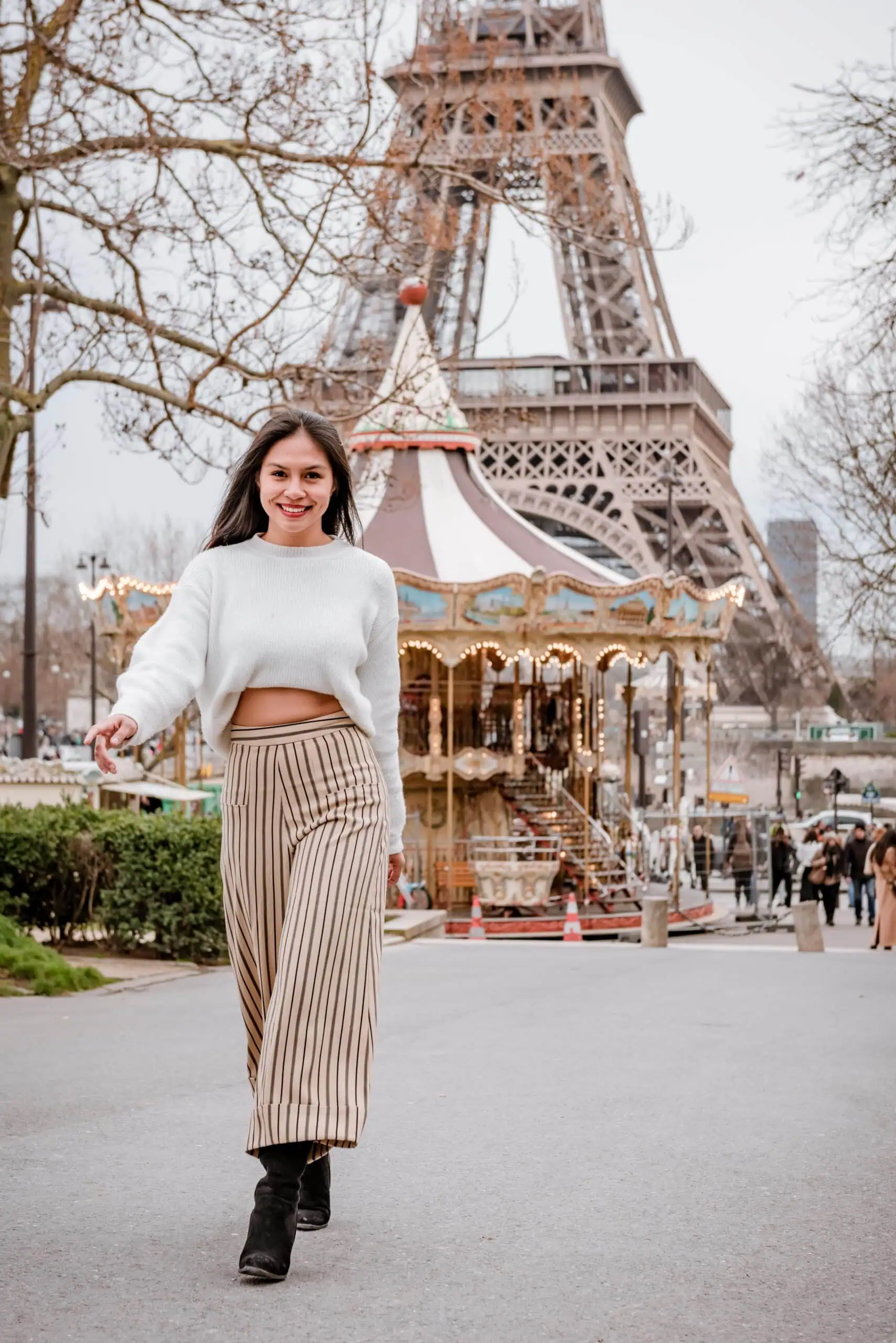
One stop per hour, grouped by area, ordered by light and crowds
Plan one location per hour of shooting, group stops that sit in the same part of the city, and put the stop with the tightest light or crowd window first. That is how a Paris photoshoot route covers several locations without rushing.
This guide is for anyone choosing between the Eiffel Tower, the Seine, the gardens and Montmartre who wants to know what fits in one session. It covers how many stops each package allows, which areas combine well, how garden closing times and the Eiffel Tower sparkle fix parts of the schedule, and three sample routes. A route that crosses the city twice spends your session in the metro instead of in front of the camera.
Plan on one location per hour of session time. Essential is 1 hour at 1 location, Signature is 2 hours at 2 locations, and Prestige is 3 hours at 3 locations. The ratio is deliberate. Each stop needs time to settle, find the light, and move past the first obvious frame into the natural moments.
Walking is part of the session. You cover 3-5 km depending on your package, so the route should connect stops on foot where it can. Adding a fourth stop to a short session means every stop gets a quick pass, and the gallery shows it.
I shoot at over 30 locations across Paris, but a good route does not use more of them. It uses the right two or three for your vision and the season. Signature at €500 is the most popular because two stops give you variety without a rush.
TipIf you want more than three stops, pick a Prestige session and keep all three in one area.
| Package | Price | Duration | Photos | Locations |
|---|---|---|---|---|
| Essential | €300 | 1 hour | 30 photos | 1 location |
| Signature | €500 | 2 hours | 50 photos | 2 locations |
| Prestige | €800 | 3 hours | 60 photos | 3 locations |
Locations in the same cluster combine easily, and locations in different clusters cost you transit time. Paris sorts into four clusters for photoshoot routing: the Eiffel Tower area, the central Seine and Right Bank, the Left Bank gardens, and Montmartre.
The Eiffel Tower cluster holds Trocadéro, Pont de Bir-Hakeim, Avenue de Camoëns and the Seine quays near the Tower. These give you three different moods in one area: Trocadéro for famous, Bir-Hakeim for moody, Camoëns for intimate. Bir-Hakeim is on metro line 6 and Trocadéro is on line 9, so even a short hop between them is simple.
The central cluster runs along the Seine and the Right Bank: the Louvre, Palais Royal and the Tuileries. The Tuileries connects the Louvre and Place de la Concorde, so the garden works as the second stop after a Louvre or Palais Royal start. The Left Bank cluster is Luxembourg Gardens and Saint-Germain. Montmartre stands alone: its steep stairs and narrow streets reward a full stop, but pairing it with the Eiffel Tower cluster means crossing the city.
Mixing clusters is possible. I just count the transit as part of the session, and I only recommend it when the second location is worth that time.
The stop with the strongest crowd pressure or the tightest time window goes first. At Trocadéro the main plaza is overrun, while sunrise is nearly empty. At the Louvre, early morning gives clean architecture around the glass pyramid. At Montmartre, early morning or late evening is critical for the stairs. Each of these loses its quality by mid-morning.
"I put the crowded stop first and the forgiving one last," Finzi says. "A garden or a bridge handles a late start. The Trocadéro plaza does not."
After the hard-to-time stop, order the rest by light. Sunrise and the hour before sunset give the softest, most flattering light. A three-stop route can therefore run from an early crowded landmark, through a mid-session shaded stop such as a tree-lined street or courtyard, and finish at a bridge or the Seine in golden hour.
TipWeekdays are quieter than weekends at the Eiffel Tower area, so a flexible date helps the first stop.
Luxembourg Gardens and the Tuileries both close earlier in winter, which can decide your stop order. Luxembourg opens early and closes at nightfall, with hours that change every fortnight according to day length. The exact calendar is published on the Senate's site, which is the Sénat garden page, and I check it before fixing a route there. A whistle from the guards signals closing, so a golden hour stop at Luxembourg in winter has to be planned against that closing time.
The Tuileries is open all week, with longer summer hours and shorter hours the rest of the year. Visitors are asked to leave 30 minutes before the official closing time, so the usable window is shorter than the posted one.
In winter, I put the garden stop earlier in the session. In summer, the gardens stay open late enough to be the last stop in golden hour. Since I am planning this in mid-November, a winter route for the coming weeks should treat the garden as an early or midday stop.
TipLuxembourg is reached by RER B at Luxembourg station or by metro at Odéon.
The Eiffel Tower sparkle is the one fixed-time event on a Paris route, so build the evening around it rather than the other way round. The official operator, the Tour Eiffel website, states that the Tower "sparkles for 5 minutes every hour on the hour". The sparkles start once the golden lighting is on, at the top of each hour.
That means the first sparkle of the evening is the first full hour after the lights come on, and that moves through the year with sunset. In midwinter there are several sparkles before the lights go off, and in June and July only one. A winter evening route has more flexibility. A summer one has a single chance, so I keep the preceding stops short.
The operator names the Trocadéro esplanade and the Champ de Mars as the best places to watch the lights. A route that finishes at Trocadéro or Bir-Hakeim lets the last stop and the sparkle coincide. The Night Session is €450 and takes place after sunset for this reason.
TipArrive at the final stop before the hour, not on it. The sparkle will not wait.
Walk between stops inside a cluster and use the metro only when you change clusters. In the Eiffel Tower area, the stops connect on foot along the river and the avenues, which keeps the session continuous and gives me natural moments between formal setups.
When a route does need a metro ride, I plan it for the transition point, for example after the morning stop and before a daytime shaded stop. The metro is not used during golden hour. The best light does not wait for a train.
Walking is part of the 3-5 km a session covers, so comfortable shoes matter more than they do on a standard sightseeing day. Layers help too, because the weather shifts through the day.
TipAsk me to confirm the meeting point and the first walk when I send the route, so the first transfer is clear.
Signature, Eiffel Tower morning: start at Trocadéro near sunrise, when the plaza is nearly empty and the lower terrace and side staircases give clean framing. Finish at Pont de Bir-Hakeim before the bridge fills with tourists. Both stops are in the same cluster, so the walk between them is part of the session.
Signature, central Paris classic: start in the Palais Royal courtyards early, before the shops open, for clean architecture and soft morning light. Move to the Louvre or the Tuileries for the second stop. This route has no Eiffel Tower, and it suits couples who want a classic Paris feel with fewer crowds.
Prestige, three moods in one area: Trocadéro for the famous frame, Avenue de Camoëns for the intimate one, and Bir-Hakeim for the moody one in golden hour. All three sit in the Eiffel Tower cluster, so the three hours are spent shooting, not travelling.
You can change the route after booking, and rescheduling is free anytime. A €30 deposit, which is non-refundable, locks your date. If the forecast or your plans change, we move the session and I re-plan the order of stops for the new light.
Tell me your dates, the session you have in mind, and the locations you prefer, and I will take it from there. I recommend booking at least 2-4 weeks in advance, especially from April to October. Light rain can create dramatic skies and intimate moods, and I work in most weather conditions.
Your gallery is delivered within 24 hours, with every image edited by me, so the route you plan is the route you see the next day.
Quick answers to the questions visitors ask before they book.
“It was very special. Finzi is very caring and enjoyable. It was a dream photoshoot experience.”
Pick a session. Choose a date. I handle the rest.
BOOK NOW